Answer Key for a Real Sea Monsters Answer Key a Real Sea Monsters Aim Higher! English Language Arts
/https://tf-cmsv2-smithsonianmag-media.s3.amazonaws.com/filer/d6/34/d634b349-4a5c-45e3-be69-70936300b129/sea-devil.jpg)
"HIC SUNT DRACONES."
This phrase translates from the Latin as "here are dragons." It is etched on the eastern coast of Asia on one of the oldest terrestrial globe maps, the Lenox Globe, dating to 1510. Though the phrase itself is plant on but one other historical artifact—a 1504 globe crafted on an ostrich egg—depictions of monsters and mythological beasts are mutual on early maps. They mostly ingather upwardly in unexplored reaches of the oceans, warning would-be explorers of the perils of these unknown territories.
One of the virtually famous of these maps is Olaus Magnus' Carta Marina, drawn betwixt 1527and 1539. Magnus (1490-1557) was the Catholic archbishop of Sweden and a prominent historian. His travels brought him farther north than any of his gimmicky European intellectuals, lending a peachy deal of perceived credibility to his accounts and publications. Carta Marina is a detailed map of Scandinavia—i of the oldest ever created—and information technology depicts the Norwegian Sea so teaming with monsters that it would seem incommunicable to escape these waters uneaten. In 1555, Magnus published Historia de Gentibus Septentrionalibus ("A Description of the Northern Peoples"), which not merely related the history, customs, and beliefs of the Scandinavian people, but likewise reprinted and described the creatures institute on Carta Marina. His standing and reputation secured the widespread acceptance of his stories.
Magnus' descriptions and drawings were copied repeatedly, with lilliputian to no modification, for centuries by such historical titans as Edward Topsell, Ulisse Aldrovandi, John Jonstonus and Conrad Gessner, whose Historia Animalium, replete with Magnus' drawings, is the first modern zoological work attempting to draw all known animals. Such repurposing ensured that these creatures were ingrained in the public mind as truth. And over the centuries, many new monsters were added to the mix.
Where did the accounts of monsters come up from in the commencement place? Were they simply fairy tales invented to scare curious minds and small children? Henry Lee, who wrote extensively on body of water creatures and monsters, emphasized that many classical monsters are not simply pure myth. In his publication Sea Fables Explained (1883), he wrote, "… the descriptions by ancient writers of so-chosen 'fabulous creatures' are rather distorted portraits than invented falsehoods, and there is hardly any of the monsters of old which has not its paradigm in Nature at the nowadays day."
These "distorted portraits" came well-nigh in part because by the 1500s extensive oceanic exploration was still express, and the fauna that chosen these places home remained virtually unknown. Publications past Magnus and those who copied him represented some of the first attempts to systematically amass and depict these animals. Mostly, their data came not from first-manus observations only from sailors' accounts of mysterious encounters while at body of water. Less often, the decomposing remains of a washed-up carcass fueled conviction in the existence of these terrible beasts.
Sailors, or beachgoers who had the misfortune to stumble upon a rotting basking shark, had no experience with such creatures. So they explained them with what they knew well: myths and legends. If they enlivened their accounts, that simply made for a better story. And then an oarfish became a 200-foot-long bounding main serpent. A giant squid became a claret-thirsty kraken. A manatee became a mermaid. Magnus and others like him gobbled upward the stories and published them alongside accurate species. The more the stories were circulated and published, the more likely people were to mistake what they did see for a monster. And the bike continued.
The atmosphere of the day too fed people's willingness to believe such tales. The 1500s were rampant with superstition. The Scientific Revolution would not beginning to make headway until later on in the 17th century. At that place was no segmentation betwixt magic and reality—the two simply coexisted, so there was no reason to doubt mythical beasts. And even when scientists began to embrace the scientific method, they still struggled to reconcile previous behavior in the supernatural with scientific discipline. Information technology would accept hundreds of years of dedicated scientific study and exploration to overturn classical and common opinion. In the case of some creatures (i.east., bounding main serpents), sightings and questions of authenticity however remain.
Today we know that the animals that inspired such hair-raising tales every bit the sea snake, leviathans and hydra and authenticated stories of mermaids and the kraken are real. They just received some creative embellishments (and sometimes blatant artistic fraudulence) along the mode. And in a world just kickoff to plow away from superstition, but all the same inclined to embrace elements of mysticism, it's not surprising that the tales were accustomed. Also, who doesn't love a good monster story?
Follow the Biodiversity Heritage Library blog and #bhlMonstersRreal on Twitter all calendar week to get the scoop on the people, books and animals that inspired some of history'due south most legendary monsters—including the full stories behind these 5 incredible beasts:
Release the Kraken
/https://tf-cmsv2-smithsonianmag-media.s3.amazonaws.com/filer/a0/67/a06702dd-749d-476a-b2bb-dfa76335ca89/kraken2.jpg)
Aristotle introduced the world to the giant squid (which he called teuthos) in 350 B.C. Only giant squids have been seen throughout the world'south oceans, and they are quite mutual in the seas effectually Norway and Greenland. Indeed, the word "kraken" comes from the Norwegian "krake," meaning "fabulous ocean monsters." The late 14th-century Icelandic saga Örvar-Oddr gives an account of the Hafgufa, "the hugest monster in the bounding main," that sounds like it might have been a giant squid.
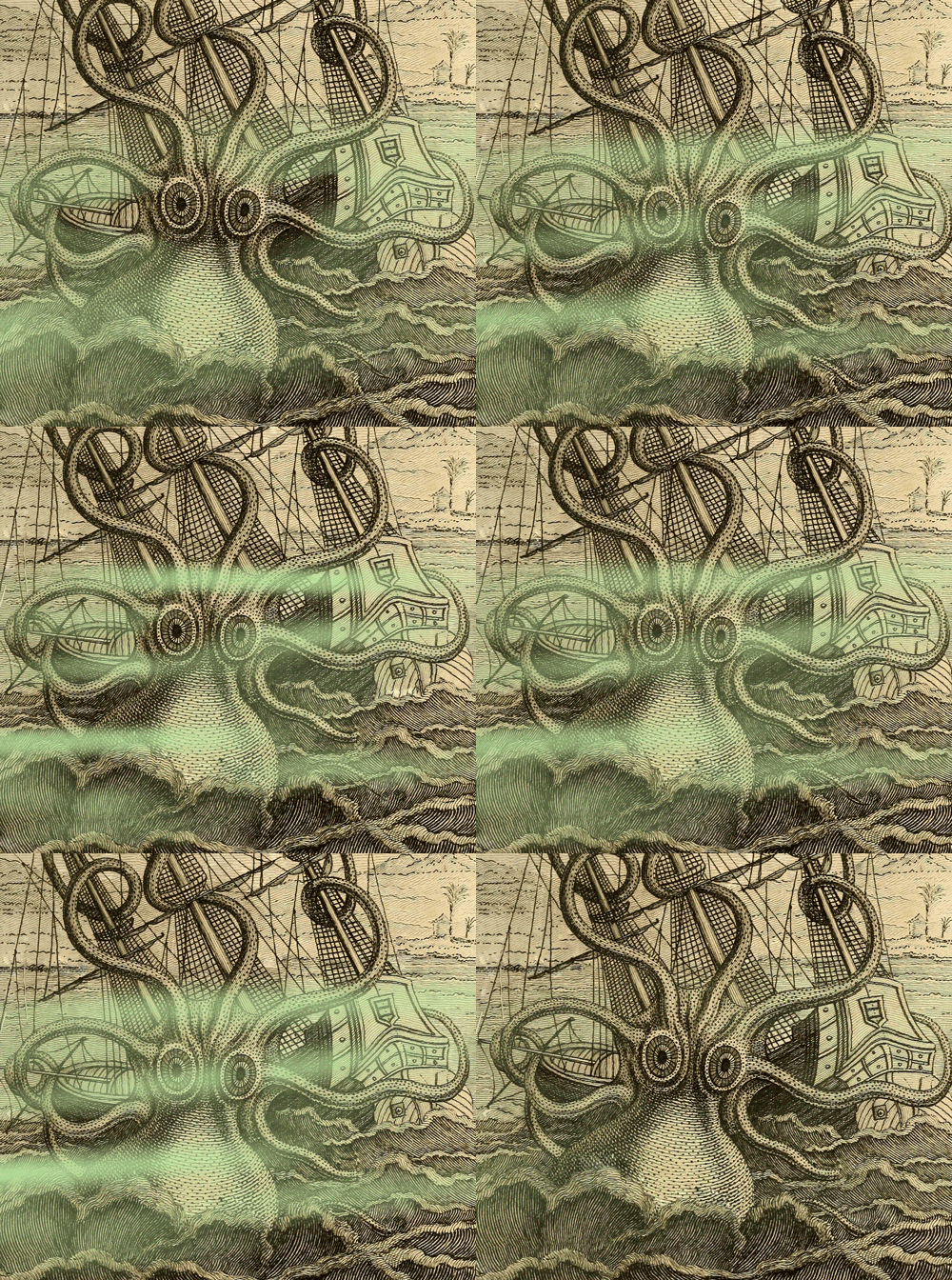
Never missing a chance to tell a skilful monster tale, Olaus Magnus detailed the kraken as a "monstrous fish" within Historia de Gentibus Septentrionalibus, describing it as having long sharp horns, huge carmine eyes, and "hairs like goose feathers, thick and long, similar a beard hanging down." He claims that "i of these Sea-Monsters will drown hands many peachy ships provided with many strong Marriners"—a characteristic reported in the earlier Icelandic work. Magnus' depiction of the brute, as a foreign mix of fish and squid, is quite different from those we find later in the literature, suggesting that his monster is likely a confusion of many sightings, including not only the behemothic squid but maybe whales and cuttlefish equally well.
In his get-go edition of Systema Naturae (1735), Carolus Linnaeus classified the kraken as a cephalopod with the scientific name Microcosmus marinus. Though it was removed from later editions of Systema, Linnaeus' 1746 publication, Beast Suecica, describes the kraken as "a unique monster" inhabiting the seas of Norway. He does, however, include a disclaimer that he has never seen the animal himself. In the mid-1800s, the kraken took an authentic biological form as the giant squidArchiteuthis, passing from myth to science. Japetus Steenstrup, a lecturer at Copenhagen Academy, introduced the behemothic squid in a paper, which referenced the primeval record of a carcass washing ashore in Thingore Sand, Iceland, in 1639. The paper was read in 1849, and the official scientific name was published in 1857.
The giant squid currently holds the record every bit the second-largest mollusk and extant invertebrate, exceeded only by the colossal squid. Contempo studies have revealed that it feeds on deep-sea fish and other squids, just its hunting methods and reproductive cycle are still unknown. While it was long believed that in that location were many species within the Architeuthis genus, recent genetic analysis suggests there is just ane: Architeuthis dux. Claims of lengths reaching 150 to 200 feet accept been reported, even by scientists, without testify to justify such claims. The Smithsonian'southward National Museum of Natural History suggests maximum lengths of nearly 60 anxiety.
Hail Hydra
/https://tf-cmsv2-smithsonianmag-media.s3.amazonaws.com/filer/eb/bd/ebbd84e5-30bf-46ab-b28b-ef112dc3f9cf/hydra.jpg)
The hydra is a "mythical" beast most unremarkably described as having nine heads, each of which will regenerate if decapitated. The Greek hero Hercules was commanded to kill a Hydra equally his 2d labor, and a marble tablet in the Vatican depicting this exploit interprets the hydra as a strikingly octopus-like monster. In his 1604 piece of work Historia Animalium, Conrad Gessner depicts the hydra, seen above, with suction-loving cup like spots on its body. Many scholars have postulated that the hydra is based on octopuses. Afterwards all, their many tentacles could be misinterpreted as heads, and octopuses tin regenerate lost limbs, peradventure explaining the unending head supply of the hydra.
Even so, many naturalists believed the hydra to be a real brute well into the 18th century. Albertus Seba, a famed apothecary from Amsterdam, boasted an extensive cabinet of curiosities filled with many magnificent biodiversity specimens. In the mid-1700s, Seba published an account of his cabinet in Locupletissimi rerum naturalium thesauri accurata descriptio, et iconibus artificiosissimis expressio, per universam physices historiam. This piece of work included an image of a hydra, based on a specimen held by the Burgomeister of Hamburg. Linnaeus afterwards proved this particular specimen to be a false, an amalgamation of snakeskins and weasel heads.
Debunking longstanding conceptions of the octopus as a terrible, vicious monster, still, has proven more difficult. Like the giant squid, the octopus has long held an unwarranted reputation every bit a monster. "Their strangely repulsive appearance, and the fictional stories of their attacks, have built up in the popular mind a picture of the 'devil fish' which no amount of accurate description is always probable to cut down to authentic size," mused Frank Due west. Lane, writer ofKingdom of the Octopus (1962).
"The octopus is, in fact, a gentle, curious creature with a surprising 'intelligence,'" argues marine biologist Richard Ellis of the American Museum of Natural History. More than than 300 species are recognized, constituting over a third of all cephalopods. They are perhaps the about intelligent invertebrates, demonstrating complex problem-solving abilities and the utilize of tools. In the instance of the octopus, information technology is more than a story of the monster that but misunderstood.
Sea Serpent on Deck
/https://tf-cmsv2-smithsonianmag-media.s3.amazonaws.com/filer/fa/c2/fac28fbb-9872-4ef3-aa1e-4d9b0a547eee/sea-serpent.jpg)
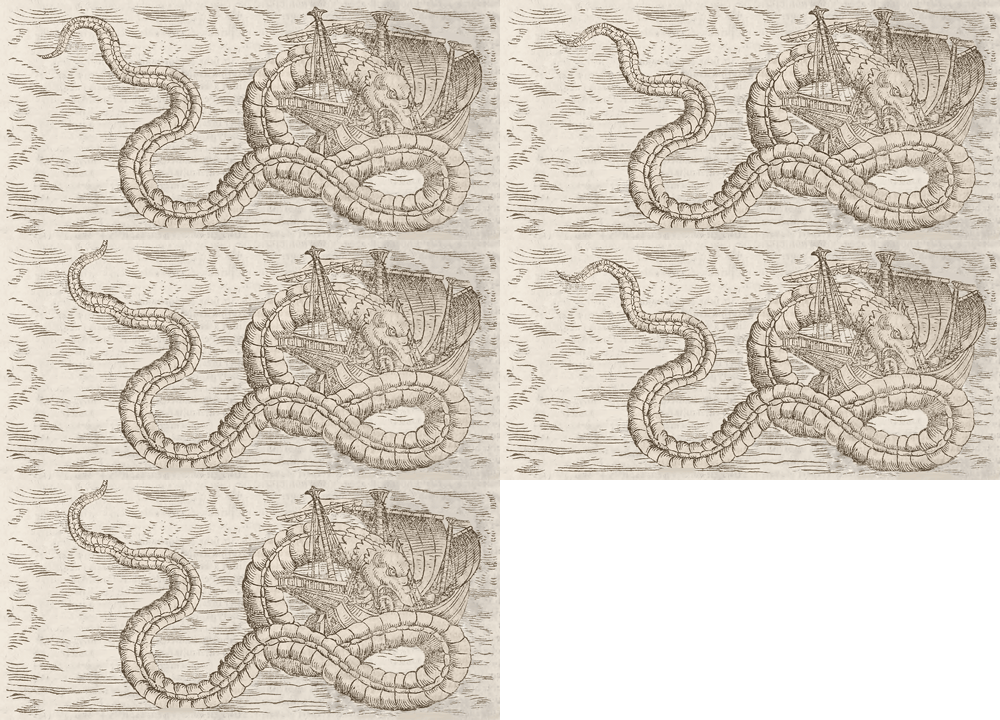
In the 16th century, people believed that a creature of unimaginable size and ferocity called Soe Orm stalked the waters. Olaus Magnus gave a gripping description of this sea serpent, accompanied by the equally formidable woodcut seen above, in the 1555 masterpiece Historia de Gentibus Septentrionalibus. The brute is 200 feet long and 20 feet wide, he writes, with "a growth of hairs of two feet in length hanging from the neck, sharp scales of a dark brown color, and brilliant flaming optics." Magnus did non come with the tale of Soe Orm on his own. The creature he describes was based on accounts from sailors and Scandinavian locals, which in turn were based on encounters with foreign aquatic creatures that became immortalized every bit sea serpents.
Descriptions of sea serpents with manes or growths of pilus about their necks are common amongst monster lore. This feature provides a inkling to 1 of the animals oftentimes mistaken for a sea snake: the oarfish. An enigmatic creature, the oarfish is the longest bony fish alive, perchance measuring as long as 45 to 50 feet. Human encounters with these fish are rare, but we know they do have a ruddy cockscomb of spines on their head and a red dorsal fin running the length of their bodies. Fleeting glimpses of oarfish could easily be exaggerated into an encounter with a monstrous sea serpent, and, to an untrained eye, the remains of such a fish washed upwardly on a beach could understandably resemble the ocean serpent of legend.
Basking sharks, measuring upwardly to forty feet in length, have besides been mistaken for bounding main serpents. In 1808, a badly decomposed carcass washed up on Stronsay. At a meeting of the Wernerian Natural History Society in Edinburgh, it was asserted that this carcass was the aforementioned creature described in accounts of sea serpents, and it was given the proper noun Halsydrus ("sea water snake"). Later analysis of the skin and cartilage revealed that the "monster" was in fact a basking shark, and inappreciably a monster. These gentle giants are passive feeders with a diet of zooplankton and pocket-size fish and invertebrates.
Ane of the near infamous sea snake episodes spanned decades. From 1817 to 1819, a mass of people, including fishermen, military machine personnel and pedestrians, reported seeing a body of water monster at to the lowest degree 80 but perhaps 100 feet long, with a head resembling a horse, in the harbor off Gloucester, Massachusetts. There were so many bystander reports that the Linnaean Society of New England formed a special investigating committee to examine the possibility of such a creature. In October 1817, two immature boys found a iii-foot-long serpent trunk with humps on a beach not far from where the sightings had occurred. The Linnaean Social club declared that the Gloucester sea ophidian had visited the harbor to lay eggs, and that the specimen the boys had plant represented one of its young. They invented an entirely new genus and named it Scoliophis atlanticus ("Atlantic Humped Ophidian"). Shortly thereafter, naturalist Alexandre Lesueur examined the specimen and reported that it was, in fact, a plain-featured common blacksnake (Coluber constrictor).
The Mighty Leviathan
/https://tf-cmsv2-smithsonianmag-media.s3.amazonaws.com/filer/6c/41/6c4144fc-e104-4c6f-9021-04eb81fef595/prister.jpg)
In the 6th century A.D., Irish cleric St. Brendan and 18 other monks sailed out from Ireland to cross the sea. During their journey, they came upon a blackness, treeless island and decided to brand camp for the night. Several monks set up a cooking station and lit a burn down. And and so the island began to move. Terrified, the monks fled back to their gunkhole, leaving the food and fire backside. St. Brandon urged them non to be afraid; it was only the great fish Jasconius, "which laboreth night and day to put his tail in his oral cavity, but for greatness he may not."
In Historia Animalium, Conrad Gessner describes Jasconius past some other name: the Trol whale, or Devil whale, which lies asleep in the water and is oft mistaken for an island by hapless sailors. Gessner was probable inspired by Olaus Magnus, who claimed that the whale'due south skin is like sand, lending to its confusion with a beach. When the sailors' dinner fires disturb the whale, it sinks, causing such a whirlpool that the ships themselves are often sunk.
Even before sailors encountered whales in the body of water, washed up carcasses, sometimes badly mutilated, ignited a fear of creatures of the deep. According to marine biologist Richard Ellis, author of Monsters of the Sea, "the sperm whale, with its mysterious habit of stranding on shallow beaches, was probably responsible for many of the legends and myths of bounding main monsters." The sperm whale (Physeter macrocephalus) is a fearsome animal even among whales. The largest toothed predator in the world, this behemoth can reach upward to 67 anxiety long and weigh as much as 125,000 pounds.
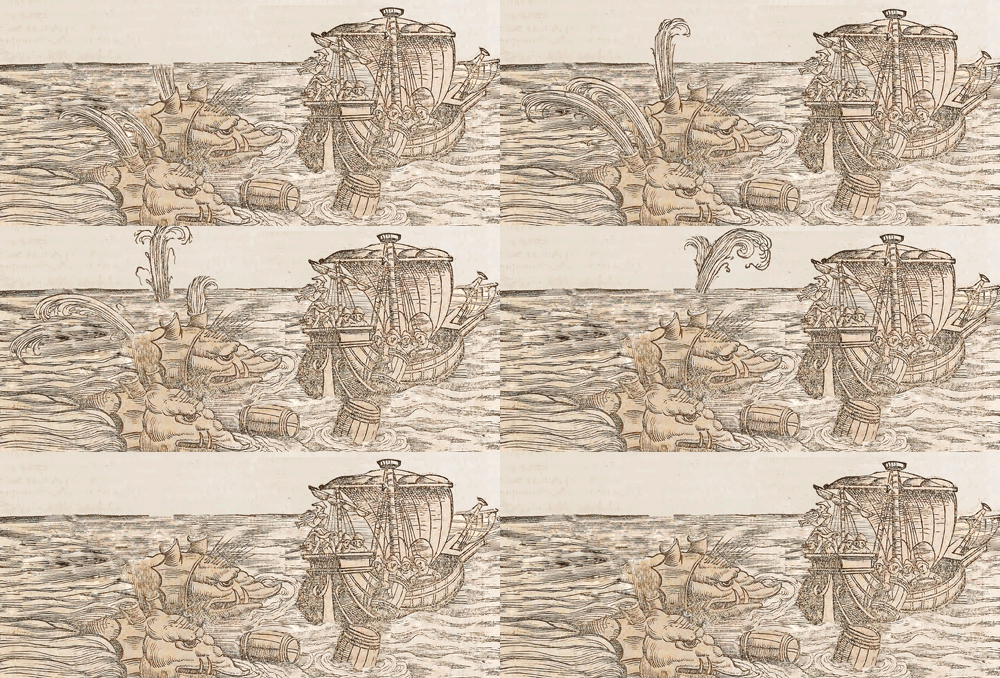
The range of monsters inspired by cetaceans is charmingly diverse. Another multifariousness, the prister, is found in multiple forms throughout Carta Marina and in many subsequent publications. Magnus identified these beasts as whales, describing them as "two hundred cubits long, and very cruel." The common characteristic amongst pristers is the presence of two blowholes, near oft interim equally h2o cannons drowning unlucky vessels. How can such a fauna be defeated? Non by cannon-burn. Magnus warns that the creature'due south layer of fat is likewise thick. Instead, try sounding a trumpet, which will startle the monster, or dump some empty barrels in the body of water, which will distract the creature and cause it to stop to play. What existent-globe animal is this monster likely based on? Baleen whales like the humpback practise have 2 blowholes.
Mermaid's Tale
/https://tf-cmsv2-smithsonianmag-media.s3.amazonaws.com/filer/15/7d/157de229-2a6c-45fe-993e-e8e85ac74802/mermaid.jpg)
The myth of a marine human extends as far back as 5,000 B.C., when the Babylonians worshipped a fishtailed god named Oannes. John Ashton, writer of Curious Creatures in Zoology, proposes that this is the get-go depiction of a merman. Also in classical artifact, Atargatis, chief goddess of northern Syria, was depicted as a fish-bodied human.
In the centuries that followed, many people claimed to actually run into mermaids. In 1492, Christopher Columbus sailed out from Spain with a mission to find a western merchandise route to Asia. Instead, he institute something altogether more than mysterious. On January 9, 1493, about the Dominican Republic, Columbus spotted 3 mermaids. He wrote: "They are non as beautiful as they are painted, since in some ways they accept a face up similar a man." In 1608, during an expedition to detect the Northwest Passage, Henry Hudson claimed that several crewmembers spotted a mermaid. From the naval upward she was similar a woman with long, black hair, but she had a tail similar a porpoise.
The official painter of the Dutch East Bharat Visitor, Samuel Fallours, included a tantalizing mermaid within his 1718 cartoon depicting the assortment of exotic biodiversity found around the islands. Francois Valentijn included a copy of Fallours' mermaid, seen above, in his publication on the E Indies, entitled Natural History of Amboina (1727). He claims that this "monster resembling a siren" was captured on the coast of Borneo. But merpeople were not always represented in a sensual light. The 13th-century Norwegian manuscript Konungs skuggsjá describes a alpine fauna with shoulders only no hands that rises from the h2o, maxim "whenever the monster has shown itself, men have always been sure that a storm would follow."
Bernard Heuvelmans studied cryptozoology, the procedure by which unknown animals go monsters, or monsters are identified as known animals. He wrote that "the mythifying procedure can sometimes be carried to the signal of altering its object beyond recognition." Case in betoken: the manatee. "Since the manatee has pectoral mammae … and a trunk that tapers to a fishlike tail, it has always been identified, on both side of the Atlantic, with the fascinating mermaid, despite its (to our optics) ugly face." The three mermaids that Columbus spotted in 1493 (or sirens as he called them), were undoubtedly manatees. He, and many explorers afterwards him, adamant that these aquatic mammals were mermaids in flesh and blood. Sightings of dugongs, a fellow member of the manatee's order, have also been associated with mermaids throughout history. Indeed, the order containing manatees and dugongs to this solar day is called Sirenia.
Source: https://www.smithsonianmag.com/science-nature/five-real-sea-monsters-brought-life-early-naturalists-180953155/
/https://tf-cmsv2-smithsonianmag-media.s3.amazonaws.com/filer/d6/34/d634b349-4a5c-45e3-be69-70936300b129/sea-devil.jpg&description=Answer Key for a Real Sea Monsters Answer Key a Real Sea Monsters Aim Higher! English Language Arts)
Post a Comment for "Answer Key for a Real Sea Monsters Answer Key a Real Sea Monsters Aim Higher! English Language Arts"